


THE CONTEXT: This story was published in the Madison Courier to celebrate the heroic life of a local business owner who sought to serve God through his family life, business, and community. His life-long mission and acts of charity were shrouded in secrecy until guests began arriving at his funeral.
THE STORY: It wasn’t long after President Franklin D. Roosevelt established a New Deal that the Civilian Conservation Corps arrived in the Ohio River valley, putting young men from families hard struck by the financial crisis to work.
Among them in 1929, was a young Anthony Joseph Dattilo Jr.
Yet, instead of the work others undertook — new infrastructure, buildings and trails within the newly established Clifty Falls State Park — Dattilo struck a different deal. A deal that acted as a foothold for the Anthony Dattilo Fruit Company.
From that time on, Dattilo Jr. provided the Conservation Corps with fresh produce and fruit.
His undertaking — 90 years old on April 1 — lives on today on the same street, block and address — 211 W Main St. — though larger after acquiring its grocery and office sides from Steinhardt Grocery and Patsy Quinn’s pool room. The sign outside still proudly proclaims, “A. Dattilo Fruit Company.”
The young Dattilo Jr., who was from a poor family of the time, was probably the only child of nine to go to college, his daughter, Donna Jackson, said. However, with the Great Depression and the discontinuation of his scholarship, he left college and traveled immediately to Madison, where his Aunt Mary and Uncle Tony Dasta put him to work in their fruit store — Dasta Fruit Company — on Mulberry Street. Uncle Tony Dasta recently had suffered a stroke, which gave young Dattilo Jr the opportunity to work the business for his uncle.
The fruit industry had been a family tradition, ever since Dattilo Jr.’s father, Anthony Joseph Dattilo Sr., emigrated to the Louisville area from Sicily. It was here, in the late 19th Century, that Dattilo Sr. sowed the seeds for his family’s future through the acquisition of his first fruit vendor cart in the city.
“My parents married Oct. 30,1929 — that’s the wedding. They look like debutante and well off — but they weren’t,” Jackson said, describing her family’s financial state. “Her name might not have been out front but she was in the back taking care of everyone. …They made sure (my mom) had a wedding. Mom said her wedding was so big and mind-boggling. …They were…married 47 years.”
Dattilo Jr. married Mary Cianciolo at St. Peter in Chains Cathedral in Cincinnati, said Anthony “Tony” John Dattilo Sr., the couple’s third child, who now runs his father’s shop downtown.
His parents were incredibly close, Tony said. They really loved each other. And, that love reflected in their marriage, family and business.
“…Dad really was the business head,” Jackson said. “He talked to (my mom) about things but it wasn’t her realm. He took care of the most important decisions with her consultation.”
Dattilo Jr. in time became a leading businessman in the city, eventually heading the Madison area Chamber of Commerce, working to bring new industry and business to town, including Williamson Heater, Chain Belt Company, and a watch company that was once housed where Royer Corporation is today.
Yet, he didn’t stop. Behind the scenes, in a history hidden in the minds of the poor, his children and the few who bore witness to his acts, he helped numerous families emigrate to the Madison area, providing resources for work, financial assistance and guidance.
“There are families in this community, that have been supported, sponsored by our family to bring them into this country.” said Clarita “Clara” Wesbecker, another daughter. “And no one will ever know.”
Her sister, Jackson, added, “There are families in this town who wouldn’t have had Christmas for years, but no one will know.”
One thing was to be known, however, and that was the familial tradition that Dattilo Jr. was carrying on. “We are a product of Sicily, the boot,” Wesbecker said of her family. “Both sides of the family are products of Sicily.”
Though it is uncertain specifically when the family arrived in the U.S., Wesbecker said it was around the 1880s. The family, comprised of poor, Catholic fishermen, was sponsored by previous U.S. immigrants that had already made the move.
They came through Ellis Island, “with coats on their backs in the hulls of ships,” Wesbecker said. The father of Dattilo Jr.’s wife, Mary Dattilo, August Cianciolo, was young then and poor. “They’d put paper inside his jacket,” Wesbecker explained. “Because he couldn’t afford a coat. That’s how they survived. And, no one gave them any money — no government money.
“They came from a country of nothing to a country of opportunity,” Wesbecker said. “All they had (was) their family, and that’s who sponsored them. When you came in, you had to prove you wouldn’t be a cost to the state — you had a family that provided for you.”
The family grew in the Louisville area, where some still reside. In a 1974 obituary, the then-87-year-old Sicilian grandmother, the wife of A. Joseph Dattilo Sr., was at the time said to have had 43 grandchildren, 89 great-grandchildren, and 5 great-great-grandchildren. That number has since grown, leading Jackson to comment that weddings and family reunions have become difficult to house and feed.
Yet, this too was another tradition, no doubt carried on from their Catholic roots. And, the Dattilo’s were a devout family.
“(My dad) got up early in the morning, (and) went to bed early with the ball game on,” Jackson said. “When he got up…he got dressed, he went to Mass, he went to work. He ate at Hinkles — Hinkles was one of his first customers.”
Dattilo Jr. didn’t go to Mass alone. Each morning, by 6 a.m., he was joined by his three sons at the then-St. Mary’s Catholic Church on Second Street, the boys served the Mass while their father prayed. And, once their morning rites and prayers were complete, they all went to work at the fruit company. That building naturally became the extension of the family home to the community, where many neighbors and friends were brought in and raised by the Dattilos, including children of other races in a time when segregation still reigned.
Dattilo Jr. and Mary had six children, including from oldest to youngest, Marina “Mary” Jo, now 88, who later worked as bookkeeper for the fruit company; Clarita Wesbecker, who also later worked as a bookkeeper; Anthony “Tony” John Sr., who was nearly always in the store, except when he was playing baseball or in school, and who now runs the store; Donna Jackson, who always stayed home to help her mother, following Italian tradition for young girls; Leonard “Lenny,” who kept the business running from his youth until around 1990 before Anthony John Sr. took over; and Thomas Martin, the youngest, who went on to become a lawyer and a county prosecutor in 1974.
In those days, back when their children had not yet grown to take on professional careers and leadership roles in the Madison community, Dattilo Jr. had the assistance of Walter King, the first to help him with the company, and his brothers, Frank and Pete, who later came to his aid.
By all accounts and stories passed through the generations, they were all dynamic characters. Frank was the youngest in the family of nine, and the most light-hearted of men. Jackson and Wesbecker said he was a good family man, a devout husband to his wife, Ethel, a strong Catholic, a storyteller, and a lover of horses and racing — so much so that he could point out a given horse’s lineage.
Jackson and Wesbecker said Frank was always quick to humorously point out that he was born on the same day as Abraham Lincoln, as if this added to his character and merit.
“He was a smart man, he just wasn’t the seriousness of Pete and (Dattilo Jr.),” Jackson said. “He didn’t take himself seriously. If you tried to put on airs, he’d bring you down pretty quickly. And, not in a mean way — they were all good guys.”
Frank oversaw the entirety of office work for some time. He was, “a master of figures,” according to Jackson. And, among the many things they all shared in common, he was self-taught and a devoted worker. After his time at the fruit company, he established his own construction company that contributed to the many houses on State Street.
Pete was the oldest of the three, and he came to help his brothers for some time. According to Jackson and Wesbecker, he was a serious, conservative character, though, he did lighten and become “quite funny” with age.
“Pete…was a good guy — straight-laced. He didn’t put up with monkey business. He didn’t take jokes lightly, he was his own person,” Jackson and Wesbecker explained. “He was strong in his beliefs and wasn’t easily persuaded. He was a strong Catholic…good cook…(and) he was a hard-working man.”
A father of four and a husband to Sara “Pinky,” he devoted much time to work, as his fathers had done before him. He mainly drove customer routes in the Cincinnati line, picking up and delivering produce.
And, as for Dattilo Jr., Jackson and Wesbecker said of their father. “He knew when to go in and when to get out (of business deals and investments). He just knew.”
“Dad,” Jackson remembered, “…was a Golden Glove Champion in boxing…He was fast. He was quick. He was an all around athlete.” In high school, he received a college scholarship for boxing, football and baseball, yet, “(He) only went for one year.”
Their father was in the national guard and used to march up and down Jefferson Street with the local troop. And, he loved baseball. “He always sat on the first baseline (to watch the Cincinnati Reds),” Jackson said.
Jackson and Wesbecker recalled a memory shared with them about the day Tony was born. Their father, a very calm man, unlike their excitable mother, was so filled with emotion and joy that he ran down to the shop and had a new painted sign added, reading, “A. Dattilo & Sons Fruit Company.” Dattilo Jr. loved his son in his own unique way, Jackson and Wesbecker said. To this day, no one knows how Anthony “Tony” John Dattilo Sr. received his father’s name, as it contradicts a long-running Italian tradition that directed the first boy and girl to be named for their grandparents and the second to be named for their parents. But, what is certain is that it reflected the deep bond the two would share throughout their time together.
And, it was through this mysterious father-son bond that the many traditions of the Dattilo blood continued, and have continued to this day through Dattilo Jr.’s sons, and on.
A. Dattilo Fruit Company was a busy place in those days. By the Second World War, the business was well established, and, because of Dattilo Jr.’s large family, he was not drafted, though, his brother Frank was. And, his brothers Pete and Gus volunteered.
Yet, just as he had done before in striking a deal with the CCC camps of Clifty Falls, he continued to strike deals to keep his family fed while also bringing new opportunities to the Madison community, his tenacity inspiring the later addition of Fort Knox to the company’s clientele.
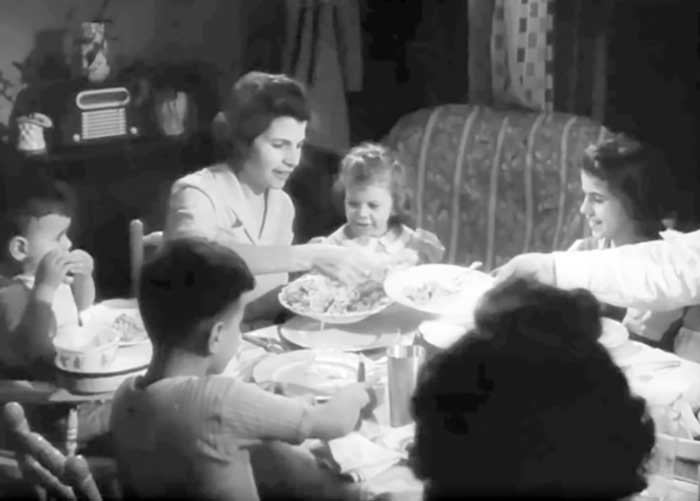
While Dattilo Jr. was a working man, the family was the sacred center of his life. The dining table was a reflection of his reverence.
“Dad never talked, he just worked,” Wesbecker explained. “There was no monkey business at the table.”
“One time he stopped the dinner table,” Jackson said, explaining a time she had been talking about people not present at the table. “(He) said, ‘if you didn’t see it with your own eyes, or hear it with your own ears, then it didn’t happen for you to repeat it here at this table. Do you understand?’
“He didn’t want us gossiping,” Jackson said. “That’s the way he wanted us raised. …We were taught to always respect our elders, and we never backtalked. He never touched us, he loved us.”
In 1949, Dattilo Jr. took a baseball team he coached to a restaurant after an out-of-town game. At the time, before the Civil Rights Movement of the 1960s had run its course, the team consisted of white and black players.
Wesbecker and Jackson described the scene after restaurant workers asked the black players to leave.
“They went into this restaurant and they informed my dad the black kids couldn’t eat there,” Wesbecker said. “My dad said — after speaking his mind — he said, ‘we are out of here. We are taking all of our business out of here and we will not be returning.’”
By the late 1970s, the company had grown to encompass a large clientele, ranging from schools and jails, to military outposts and forts.
On June 20, 1977, after his many years of loving devotion and difficult work, Mary Dattilo and her six children lost their father to a sudden, peaceful death.
Jackson recalled her father having repeated on many occasions the saying, “I never go to bed without balancing the books.” When she asked her father what he meant, he explained that he always made sure he was right with the Lord before closing an eye, because he thought he might pass in his sleep.
And, after the many years of such a close bond, Mary found it difficult to live without her husband, though, according to Wesbecker and Jackson, after going through her husband’s things, she discovered a note left purposely behind for her.
It read, “Mary, take one day at a time.”
That is what the family has done ever since. Five years after her husband’s death, Mary followed in the spring of 1982, leaving her children to carry on all she and her husband had taught them.
And today, 90 years following their father’s arrival in Madison to work for his family, Dattilo Jr.’s son Tony continues the heritage of his ancestors. Through difficult times, loss, tragedy and pains, he persists.
“Dad is looking down,” Jackson said, explaining how hard her brother Tony has worked to keep his father’s mission alive. “I know he is incredibly proud.”
The store opens each day at 6 a.m., where customers can find Donald Morris. Tony will tell you that it has taken many hands to keep his father’s company alive and well.
“If it hadn’t been for these six men — Walter King, Frank, Pete, (Dattilo Jr.), Leonard and Donald Morris,” Tony Dattilo said. “This place wouldn’t be here without them.”
THE FRONT PAGE ANNIVERSARY STORY:
A nickel for an apple then, 70 cents to a buck today — 90 years has changed a lot, and the Anthony Dattilo Fruit Company has witnessed it all.
Monday, April 1 will mark those 90 years.
From their humble roots in the Great Depression, the fruit company, at 211 W Main St., has hardly changed, still offering fresh fruit and produce at affordable prices to schools, corporations and jails, once even supplying Fort Knox.
“The company mission is still exactly the same,” Clarita “Clara” Wesbecker said this week as she talked about her dad, who started the company. “They provide the finest quality and quantity you need, and if something ever happened (to disappoint you), he would make it right twice around.
“Since we don’t have a grocery in (downtown) Madison it’s a blessing to go down there and grab fresh, long-lasting fruit.”
Today, the company is run by its founder’s son, Anthony “Tony” John Dattilo Sr. and Donald Morris, who can be found at the store any given day well before the sun peeks overhead on Main Street.
And, from 6 a.m. to 2 p.m., customers can catch these men leading others in route deliveries throughout a 40-mile radius of the storefront.Monday will mark 90 years of this continued tradition.
Since their founding, the company has seen the development of Clifty Falls State Park, the Second World War — the era when the shop’s family was showcased in a war film — the Cold War, the development of North Madison, the rise of refrigerators, color TV, the Civil Rights movement, and the shifting landscapes of downtown and the surrounding area.
(PUBLISHED MARCH 30, 2019, THE MADISON COURIER)
